Student Accommodations
What are student accommodations in the MD Undergraduate Program, and what should preceptors know about them?


This page provides an overview of student accommodations, answers frequently asked questions, and explores some case scenarios.
For more in-depth questions about student accommodations, please reach out to your program contact.
What are Student Accommodations?

Accommodations are administered by the Centre for Accessibility, a dedicated unit at UBC [1]. Accommodations provide an accessible learning environment to students with disabilities or ongoing medical conditions while upholding essential program requirements, professionalism standards, and patient safety. This may mean making adjustments to the tasks, environment, or the way things are typically done to enable the learner to have equal opportunity to participate.
Examples may include, but are not limited to:
-
- Adjustments to clinical or call schedules
- Placements at specific hospital sites or limited to a geographical area
- Time off for medical appointments
- Access to specialized equipment or furniture
- Extended exam times
- Assistive technology
- Alternative format materials (print, electronic, etc.)
What are Academic Concessions?
Academic concessions assist students who experience unanticipated events or circumstances that may interfere with their ability to achieve their learning outcomes in the short-term. [2] Examples include, but are not limited to: pregnancy or new parenthood [3], a death in the family or of a close friend, etc.
If adaptations need to be put in place for the long term, the student will pursue formal accommodations with the Centre for Accessibility.
In short:
Accommodations are legally mandated supports to remove barriers for students with disabilities. They are determined by the UBC Centre for Accessibility.
Academic Concessions are made to address student life events and circumstances when they impact learning outcomes, when deemed appropriate by course faculty leads.
Did you know…
Research has found that ableism (persistent, exploitative, or abusive disability-related discrimination that creates intimidating or offensive environments and violates the dignity and security of people with disabilities) in medical education has created a disproportional under-representation of people with disabilities in healthcare professions [a,b]. This has highlighted the need to support diverse learners in recruitment, retention, and teaching in medical education, for example, through student accommodations. For more on ableism in medical education, see Am I Ableist? in the Additional Resources below.
Since clinical learning environments are also professional and patient-care environments, the benefit of these efforts to be more inclusive extend beyond preceptors and students to include patients and colleagues, advancing equity in healthcare overall.
Clinical learning takes place in busy, complex environments where many factors are outside a clinical teacher’s direct control, and creating inclusion and belonging does not rest solely on the clinical teacher’s shoulders. Nevertheless, clinical teachers have a particularly strong impact on shaping this environment [c]. Thank you for your efforts to provide inclusive and supportive learning environments for students.
Frequently Asked Questions
Receiving Notice of an Accommodation
How do I know if a student requires an accommodation?
Can I ask for the reason behind an accommodation?
All medical information is treated as private and confidential. You may reach out to your site year lead to clarify an accommodation (for example, modification options or specialized equipment), but not the reason behind an accommodation.
Students may choose to self-disclose or provide further information, but it is not required or expected as part of the implementation of accommodations.
Please do not share a student's accommodation with other students.

Table from Instructor FAQs on Accommodation by the UBC Centre for Accessibility
How far in advance will I be notified about an accommodation?
Students may seek accommodations at any time. In the MD Undergraduate Program, accommodation notifications are typically shared as soon as the program receives them and can implement them. One exception is in Year 4 electives, where accommodation notifications are only shared after the change/add/drop elective deadline, when the student’s schedule is considered confirmed.
Supporting Accommodations
What if I don't think I have the resources to support the accommodation?
Please reach out to your site year lead or course director for guidance; they can work to ensure that a student’s accommodations are met whether it is related to the physical space or time/task restrictions.
How do I manage negative comments made to/about students and their accommodations?
While we strive towards creating supportive and inclusive learning environments, you may encounter negative comments about a student’s accommodations. Clinical teachers have an obligation to provide all learners with an environment that offers equitable access to education and training, which includes speaking out when ableist comments or behaviours appear in our teaching environments.
The following resources offer tips and strategies for improving and upholding inclusivity standards in our classrooms and clinical learning environments. These strategies can also support a shift in culture, where long hours, fatigue, burnout, etc. in medicine are discussed, and compassion and/or support is offered to everyone.
- Supporting Inclusive Clinical Learning Environments module: Learn the principles of inclusive teaching in clinical learning environments.
- Inclusive Language Guide: These guidelines highlight current principles, best practices, and examples for applying inclusive language.
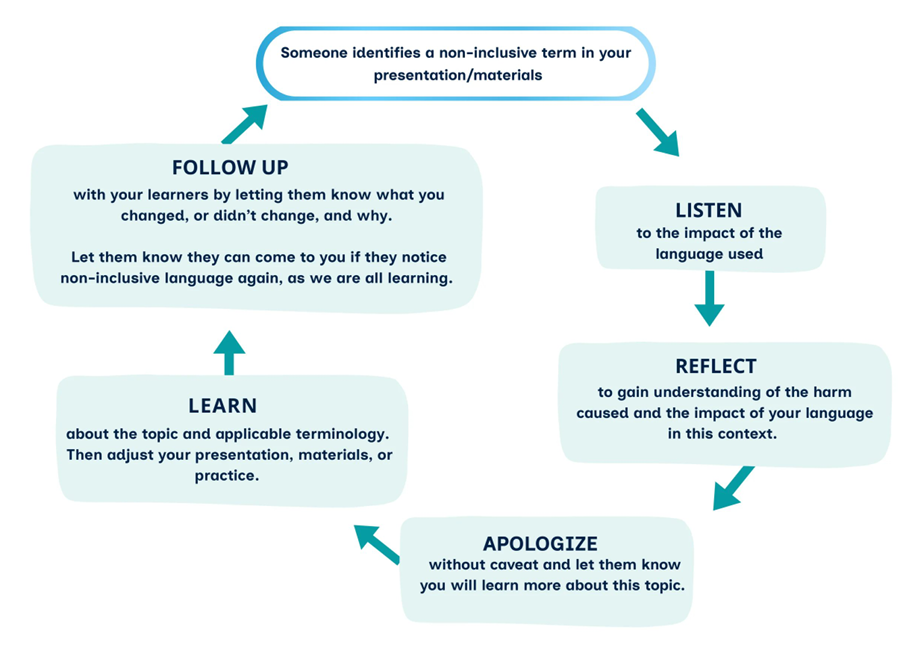
Image from the Inclusive Language Guide - Appendix 1: Response and Adaptation Framework
Assessing Learners with Accommodations
Does having an accommodation allow a student to opt out of completing their required coursework or clinical work?
No. Accommodations do not change the learning outcome or required competencies; they may just change the way in which the student meets the outcome.
I have assessment concerns regarding a learner's accommodations
UBC has a competency-based medical curriculum, and therefore every student is expected to achieve the same competency regardless of an accommodation. Some learners are able to achieve this with reduced clinical hours while others may require additional time scheduled.
Verbal and written feedback provided to an accommodated learner should not be any different than feedback provided to other learners. For example, a student who is unable to do overnight call would still be expected to have sufficient clinical exposure to meet the competencies of that clinical learning activity and therefore receive feedback on their achieving (or not) of that competency.
If you feel a student cannot be assessed due to inadequate time in a course or insufficient exposure in a rotation, please reach out to the course director or site year lead, preferably as early as possible so that they can coordinate how the competencies can be met.
What to Expect – Case Scenarios
UBC Resources & Policies
The resources below are provided to help guide you in supporting your learners with accommodations.
For detailed support, we recommend connecting with your site director.
UBC Resources and Policies
- 1. UBC’s Centre for Accessibility
- 2. UBC’s Senate Regulation on Academic Concessions
- 3. Pregnancy and New Parenthood During Medical School – Policy 044
- Student Accommodation Policy and Procedure (Policy 33)
- Disability Accommodation (Policy LR7) (see also: a guide to understanding Policy LR7)
- How are Student Accommodations Administered? (Infographic)
Faculty Development Resources
- Welcome a Learner to Your Practice
- Creating Goals with a Learner
- Giving Feedback after a Direct Observation
- Dr. Lisa Meeks’ Webber Lecture, Creating Inclusive Training Programs for Trainees with Disabilities (40 minutes)
Additional Resources
- Meeks L, Neal-Boylan L (Editors). Disability as Diversity: A Guidebook for Inclusion in Medicine, Nursing, and the Health Professions
- Am I Ableist? Disability Awareness in Healthcare, a 23-page e-book to guide self-reflection on how ableism has been historically and persistently present in medical care, and how to apply more inclusive practices as a healthcare professional
- Docs with Disabilities Initiative/Podcast: The DocsWithDisabilities team uses research, education, and sharing of stories to drive change in policy and procedure leading to more inclusive educational environments for students with disabilities.
References
- Lindsay S, Fuentes K, Ragunathan S, Lamaj L, Dyson J. Ableism within health care professions: a systematic review of the experiences and impact of discrimination against health care providers with disabilities. Disabil Rehabil. 2023;45(17), 2715–31. Doi: 10.1080/09638288.2022.2107086
- Haywood C, Lagu T, Salinger M, López-Rosado R, DeJong C, Iezzoni LI. “The Forgotten Minority”: Perpetuation of Ableism in Medical Education. J Gen Intern Med. 2025 May;40(6):1378-86. Doi: 10.1007/s11606-024-09308-2. Epub 2025 Jan 15. PMID: 39815131; PMCID: PMC12045842.
- Boyle J, E. Chan S, Joneja M, Gauthier S, Leung M. An identity on guard: the impact of microaggressions on the professional identity formation of residents. BMC MedEduc. 2025 Feb 14;25(1):242. Doi: 10.1186/s12909-025-06818-3