Artificial Intelligence and Teaching in the Faculty of Medicine
Artificial Intelligence (AI) is an emerging and rapidly evolving field that is increasingly influencing teaching and learning within the Faculty of Medicine. We are working with faculty experts to curate resources for teachers looking for guidance on AI use in their teaching. This page will be regularly updated.

The Faculty of Medicine is in the process of developing a comprehensive AI Vision and Strategy to guide the responsible integration of AI across our academic, clinical, and operational activities.
Faculty Development Resources
Our Artificial Intelligence (AI) Workshop series aims to guide and facilitate discussions about how generative AI tools intersect with medical and health professions education
Beyond the Basics: AI for Clinical Teaching (Intermediate level workshop)
This workshop is an in-depth exploration of teaching using AI in the clinical environment and includes case-based discussion and practice.
Audience: Faculty who are experienced with using AI in the clinical teaching environment
Date & Time: January 21, 2027 | 5:30-7:00pm | Zoom
CLICK TO REGISTER
Join the Community of Practice on AI in Teaching and Learning to share current insights, discuss relevant research, and learn about the latest tools.
AI Community of Practice
2026 Dates & Times: September 23 & November 19 | 12:00-1:00pm | Zoom
2027 Dates & Times: February 3, April 27 & June 14 | 12:00-1:00pm | Zoom
CLICK TO LEARN MORE & REGISTER
Past AI Workshops - Summary Documents & Session Recordings
AI in Teaching 101 - A Novice Level Workshop
This workshop provides an introduction to AI covering foundational principles and considerations for teaching in both the clinical and classroom environments. Presentation, facilitated activty and discussion with Lucas Wright and Kevin Shi.
View the session recording AI in Teaching 101
The Role of Generative AI for Teaching in the Clinical Context
Using generative AI to support clinical teaching, including examining relevant issues, implications and principles related to using AI. Presentations from Lucas Wright, Grainne McElroy, Joseph Anthony, Adrian Yee, Kevin Shi & Johnny Chang.
The Role of Generative AI to Enhance Teaching in the Classroom
Using Generative AI to support classroom teaching in medical and health professions education, including examining issues relevant to AI use and practicing using AI for common teaching and learning tasks assocaited with the classroom setting. Presentations from Lucas Wright, Kevin Shi, Joseph Anthony & Johnny Chang.
Teaching and Learning with Generative Artificial Intelligence in Health Professional Education
Dr. Adrian Yee and Lucas Wright discuss considerations and reflections around AI use in health professions education.
Quick Tips for Teaching (QTips) – Artificial Intelligence (AI) in Critical Thinking
Our QTips give teachers a quick, easy way to get tips on key topics. You will be able to immediately apply what you have learned to make the most of your time with your learner. This resource on AI provides a framework to help you and your learners collaborate on a joint understanding of the role of AI in critical thinking by going through the following questions:
-
- What can and can’t AI do?
- What are the risks of AI outputs?
- What are the risks of AI use on learning?
- How can I assess my learners’ AI use in the context of developing their critical thinking skills?
Explore the resource: Artificial Intelligence (AI) in Critical Thinking
Faculty of Medicine Resources
Digital Solutions – AI Support for Faculty
Discover how AI can support your teaching in a safe, supportive, and personalized 30‑minute one‑on‑one Zoom session designed specifically for faculty who are curious but new to these tools.
These drop‑ins give you hands‑on guidance with UBC‑approved AI (CoPilot Chat), key privacy insights, and practical ways to explore how you might integrate AI into your teaching and learning practice.
Designed for faculty who are interested in using AI in teaching and learning but don’t know where to start.
Sign up by emailing Digital Solutions’ Edtech team: edmedia.med@ubc.ca
Artificial Intelligence (AI) in the Faculty of Medicine
Learn more about the Faculty of Medicine’s AI strategy and explore guidance, resources and tools designed to help you use AI responsibly, safely and effectively. Find information on:
-
- the Faculty’s AI strategy and what it means for you
- foundational concepts and best practices for using AI
- guidance, training, and support for using AI
Looking for specific policies, guidelines and frameworks? The Faculty has developed guidance to help Health Professions Education communities such as learners, teaching faculty and administrative staff. They give guidance and support on educational quality, equity and inclusion, and ethical practice in AI use. For direct links:
Generative AI Tools to Support Development of Written Exam Questions for the MD Undergraduate Program (MDUP)
UBC Faculty of Medicine Framework for Generative Artificial Intelligence (AI) in Education recognizes the value of generative AI tools to support learning. This guidance was created to support faculty’s choice to adopt generative AI tools to asist with multiple-choice question (MCQ) development.
View the PDF: Creating Multiple Choice Questions including Prompt Generation Using AI
UBC Resources
Generative AI Guidelines
UBC has created the www.genai.ubc.ca site to help faculty and learners explore UBC’s generative AI (GenAI) principles and guidelines for teaching and learning. As GenAI tools and platforms continue to expand and evolve, it is important to provide the UBC community with guidance and advice related to their opportunities as well as risks and challenges.

Striking the right balance between AI and human interaction is crucial. The resources on this page aim to support faculty, staff and students in responsible GenAI use. Includes information on:
Principles for the use of generative AI tools – includes information on GenAi usage, content ownership, security and risk management, and social and enviornmental impact
Teaching and learning guidelines – includes ‘Principles for GenAI in Teaching and Learning’ downloadable PDF
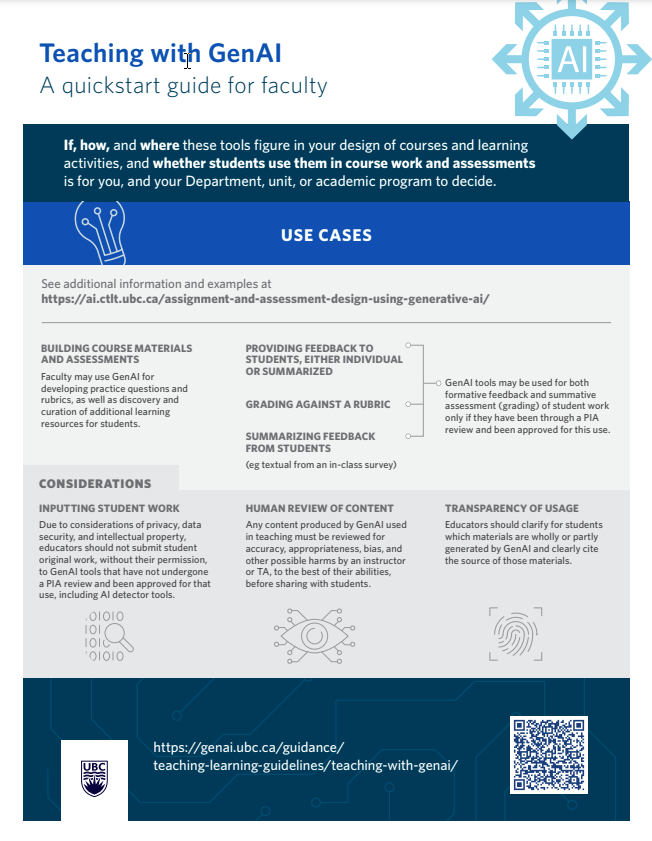
Teaching with GenAI – ‘Teaching with GenAI – A Quickstart Guide for Faculty’ downloadable PDF
The Centre for Teaching, Learning, and Technology (CTLT) – AI in Teaching and Learning
The Centre for Teaching, Learning, and Technology (CTLT) at UBC Vancouver, and the Centre for Teaching and Learning (CTL) at UBC Okanagan support faculty and staff with the use of Generative Artificial Intelligence (Generative AI or GenAI) in delivery of their teaching and learning.
Explore CTLT’s AI in Teaching and Learning webpage.
Here you can events and resources including:
See which GenAI tools are privacy impact assessment (PIA) approved for instructional use.
Learning Technology Innovation Center (LTIC) – AI and Sustainability

LTIC is UBC’s new Learning Technology Innovation Centre and aims to meet UBC’s needs for faculty and students using and transforming learning technology.
UBC community members have well founded concerns and questions about the environmental impacts of AI use as we face the reality of an expanding digital footprint for our institution. Find out:
-
- what the university is doing
- what inidiviudal community members can do
- our current understanding of the environmental footprint of AI tools
Visit the page AI and Sustainability: Our Responsibility to learn about what UBC is doing to respond to the rising environmental impact of digital tools including AI.
You can also join the conversation to help evolve UBC’s understanding of AI and sustainability.
Academic Integrity
Master of Educational Technology (MET) AI Literacy Hub
This resource was created for graduate students in UBC’s Master of Educational Technology (MET) program and for the broader community of educators, learning designers, and educational technology professionals. The hub is designed to support anyone navigating the changing role of AI in education.
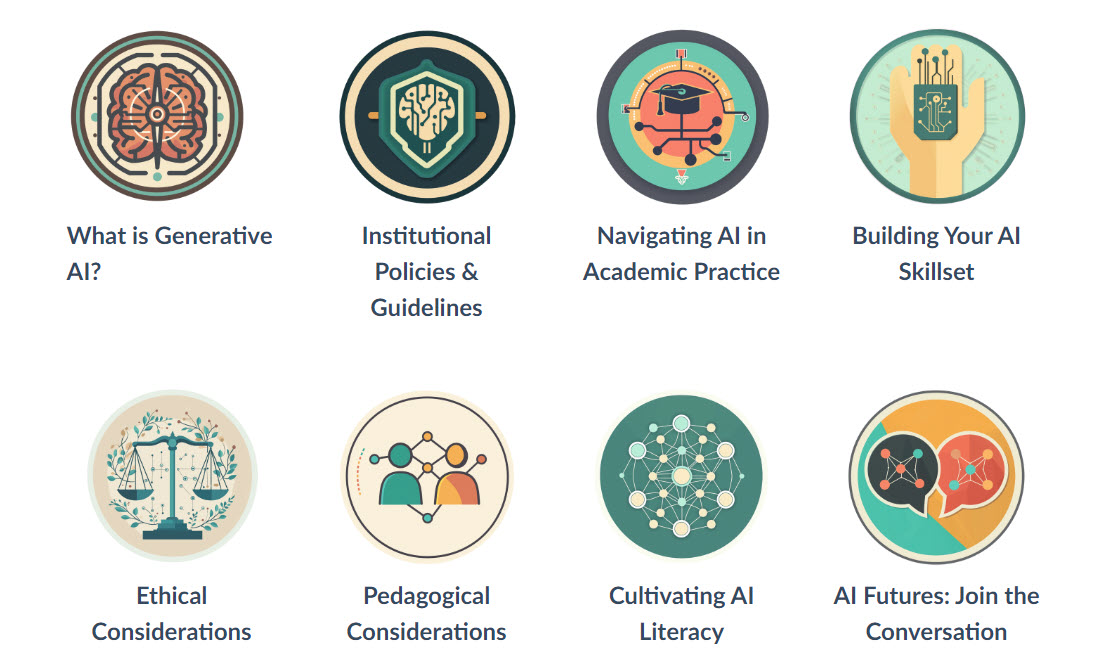
This hub maps key areas of AI literacy relevant to educational theory, practice, design, and ethics. It offers:
-
- Conceptual frameworks
- Ethical considerations
- Tool guides
- Examples use cases
Additional References & Resources
Abdulnour, R. E. E., Gin, B., & Boscardin, C. K. (2025). Educational strategies for clinical supervision of artificial intelligence use. New England Journal of Medicine, 393(8), 786-797. DOI: 10.1056/NEJMra2503232
Masters, K. (2023). Ethical use of artificial intelligence in health professions education: AMEE Guide No. 158. Medical teacher, 45(6), 574-584. DOI: 10.1080/0142159X.2023.2186203
Gordon, M., Daniel, M., Ajiboye, A., Uraiby, H., Xu, N. Y., Bartlett, R., … & Thammasitboon, S. (2024). A scoping review of artificial intelligence in medical education: BEME Guide No. 84. Medical Teacher, 46(4), 446-470. DOI: 10.1080/0142159X.2024.2314198
Wraith, C., Carnegy, A., Brown, C., Baptista, A., & Sam, A. H. (2025). Can educators distinguish between medical student and generative AI‐authored reflections? Med Educ. 2025 Jul 2. Epub ahead of print. DOI: 10.1111/medu.15750
College of Physicians and Surgeons of BC: New Ethical Principles for Artificial Intelligence in Medicine interim guidance
Doctors of BC: Practical Considerations For Using AI Scribes
AI Rounds podcast by the Cumming School of Medicine: All episodes of the AI Rounds podcast on Spotify